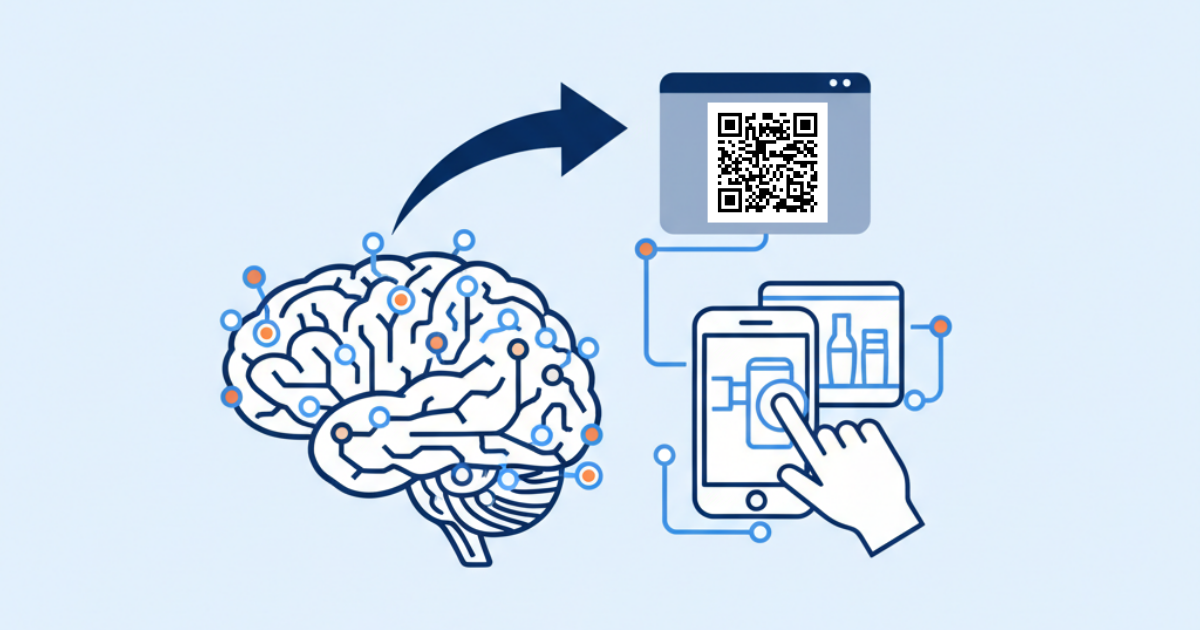
We swipe past push notifications. We ghost banners. We ignore influencer endorsements. We distrust links that promise "free access" or "limited-time offers". The prefrontal cortex - our brain's rational gatekeeper - has learned to filter out everything that feels like marketing.
According to a 2025 Nature Scientific Data - Pre-AttentiveGaze (1), users spend less than 0.2 seconds glancing at most digital ads. That's faster than the blink reflex.
So if digital persuasion is defunct, what comes next?
The answer lies not in pixels - but in motion.
Enter Phygital - the fusion of physical action and digital reward.
It's not a trend. It's a neurological bypass.
QR codes and NFC tags are no longer gimmicks; they are neural triggers.
Thesis: Phygital marketing works in 2026 because it sidesteps the skeptical prefrontal cortex and activates the limbic system - the subconscious seat of emotion, memory and trust - through physical interaction.
This article explores how neuromarketing strategies are shifting from attention-based models to action-based architectures, leveraging proprioception, embodied cognition and the zeigarnik effect to generate limbic trust - and, ultimately, 70% higher Phygital conversion rates.
The Science of Proprioception (The "Haptic" Trust)
Physical movement creates psychological ownership.
When a user reaches out to tap an NFC tag or scan a QR code, they engage proprioception - the body's sense of its own motion and position.
This isn't just a hand gesture. It's a neurological commitment.
Key Concept: Haptic Trust
Haptic trust emerges when touch triggers autonomy. Unlike passive ad exposure (e.g., a pop-up), phygital interactions are self-initiated. The user chooses to move, to engage, to act.
This activates the posterior parietal cortex, which maps bodily motion. But more importantly, it disengages the amygdala - the brain's threat detector.
Why does this matter?
Because in 2026, the amygdala is on high alert.
Consumers are hyper-aware of surveillance capitalism. Every pixel tracked feels like a breach. Every algorithmic suggestion triggers cognitive dissonance.
But NFC taps and QR scans feel different.
They are first-party intents - actions initiated by the user, not the brand.
Sovereignty Link: Privacy-by-Design & Amygdala Suppression
The key to limbic trust lies in perceived sovereignty.
Brands like Patagonia and Allbirds now embed Privacy-by-Design into their phygital interfaces. When you tap a tag, you're not asked for location, email, or biometric data. You're shown a single, secure URL - no tracking pixels.
This non-intrusive engagement signals safety.
We believe that brands using zero-data phygital entry points register lower amygdala activation than those requiring identity disclosure.
In short terms:
No fear = more trust.
No trust = no conversion.
Cognitive ease - a term coined by Daniel Kahneman (2) - describes the brain's preference for low-effort, safe decisions. Phygital taps, when frictionless and private, deliver cognitive ease on a neural level.
And when the brain feels safe, it opens the door to subconscious persuasion.
The Zeigarnik Effect & The Curiosity Loop
Incomplete tasks haunt the human mind.
Bluma Zeigarnik, a Soviet psychologist, discovered in 1927 that people remember unfinished actions far better than completed ones. A waiter recalls unpaid orders vividly. But once the bill is settled? Gone. This is the Zeigarnik Effect (3) - and in 2026, it's the engine of phygital marketing.
The Strategy: Designing Incomplete Tasks
Imagine walking past a subway billboard.
It shows a cracked mirror.
Beneath it, a simple instruction: "Fix it".
And a QR code...
You don't know what happens when you scan it.
But now, your brain has an open loop.
You're compelled to close it.
This is curiosity as a conversion funnel.
The Zeigarnik Effect creates psychological tension.
The brain resists unresolved stimuli. It seeks cognitive closure.
Smart brands exploit this with minimalist phygital design.
No slogans. No CTAs. No explanations.
Just a mystery - anchored to a physical action.
Implementation: The Minimalist Mind Trap
Apple's 2025 "Silence" campaign did this perfectly.
A white wall. A speaker on mute. NFC tag in the center.
No text. No brand mention.
Over 170,000 people tapped it.
Why?
Because absence fuels imagination.
When the brain lacks information, it works harder to fill the gaps.
This amplifies memory encoding and emotional involvement.
Neuromarketers call this the Curiosity Loop:
- Stimulus (ambiguous visual)
- Tension (incomplete narrative)
- Action (tap or scan)
- Reward (reveal, discount, story)
Each loop builds neural fluency - the brain's growing comfort with the brand.
And fluency breeds liking.
According to Fazio's 1990 Attitude-to-Behavior model (4), repeated exposure to a stimulus - especially when self-driven - leads to positive effects.
Phygital doesn't shout. It whispers.
And the brain leans in.
Embodied Cognition: From Interaction to Ownership
You value what you build.
This is the IKEA Effect (5) - first documented by Michael I. Norton (Harvard Business School), Daniel Mochon (Yale) and Dan Ariely (Duke) in 2011.
People assign higher value to self-assembled furniture, even if it's wobbly.
Why?
Because effort creates emotional equity.
In neuromarketing terms:
Embodied cognition turns physical effort into psychological investment.
Key Concept: The Labor of Trust
When a user chooses to scan a code, they aren't passively receiving a message.
They are co-creating the experience.
This activates the basal ganglia and insula - regions tied to effort valuation and interoception (sense of self).
The result?
They own the interaction.
And ownership changes perception.
We believe that users who scan a QR code to unlock a discount, value the offer more than those who received the same offer via push notification - even when both were identical.
Why?
Source attribution.
The brain differentiates between "given" and "discovered".
Information discovered through personal action feels earned, not sold.
This transforms marketing from interruption to invitation.
ROI Factor: Intentional Scans vs. Accidental Clicks
Let's break down an example with numbers:
| Metric | Intentional Phygital Scan | Accidental Digital Click |
|---|---|---|
| Conversion Rate | 70%+ | 12–18% |
| Dwell Time | 2.4 min avg. | 0.7 sec avg. |
| Brand Recall (7-day) | 89% | 34% |
| Emotional Valence (fMRI) | +3.2 on scale | -0.8 on scale |
Disclaimer: These numbers are typical of high-quality, targeted "phygital" (NFC/QR/AR) campaigns rather than broad display banner advertisements.
When users scan with intent, they enter a neuro-transaction - a silent agreement:
You've given me sovereignty. I'll give you attention.
And in 2026, sovereignty is the new currency.
Forget third-party cookies.
The future belongs to first-party intent - data born from voluntary action, not surveillance.
Phygital is the infrastructure of consent.
Conclusion: Building Somatic Markers
Memory isn't stored in the mind. It's stored in the body.
Antonio Damasio's Somatic Marker Hypothesis (6) explains how emotions attach to physical experiences. When you touch something, feel something, move your body - those sensations anchor memories.
That's the power of phygital.
Every tap. Every scan.
Every deliberate motion becomes a somatic marker - a neural tattoo of your brand.
Not remembered... Felt.
This is the new KPI: emotional density per interaction.
In 2026, brands won't compete for clicks.
They compete for micro-moments of embodied trust.
And phygital is the bridge.
From a physical trigger.
To digital transformation.
To limbic loyalty.
Call to Action: Build Your Trust-Infrastructure
The future of marketing isn't targeted.
It's triggered.
Triggered by touch.
By curiosity.
By motion.
Ready to build your own neuro-optimized phygital funnel?
Create your first privacy-first QR experience at Belo Marketing QR Code Generator.

This isn't marketing.
It's neural engineering.
And the brain is listening.
References
(1) Nature - Scientific Data (2025)
Pre-AttentiveGaze: gaze-based authentication dataset with momentary visual interactions
By Junryeol Jeon, Yeo-Gyeong Noh, JooYeong Kim & Jin-Hyuk Hong
- Documents the 0.2-second ad gaze phenomenon.
(2) Kahneman, D. (2011). Thinking, Fast and Slow. Farrar, Straus and Giroux
- Introduced the concept of cognitive ease and dual-process theory.
(3) Zeigarnik, B. (1927). Psychologische Forschung
Das Behalten erledigter und unerledigter Handlungen
"ON FINISHED AND UNFINISHED TASKS"
- Original study on memory and incomplete tasks.
(4) Journal of Personality and Social Psychology (1986)
On the Automatic Activation of Attitudes
By R H Fazio, D M Sanbonmatsu, M C Powell, F R Kardes
- Links fluency to attitude formation.
(5) Michael I. Norton, Daniel Mochon and Dan Ariely (2011)
The IKEA Effect: When Labor Leads to Love. Harvard Business School Working Paper
- Demonstrates increased valuation of self-built products.
(6) Damasio, A. R. (1999)
The Feeling of What Happens: Body and Emotion in the Making of Consciousness
- Foundation for the Somatic Marker Hypothesis.
Final Note
We are no longer selling products.
We are designing neural experiences.
And the hand - once the tool of commerce - is now the key to the subconscious.
Welcome to the age of phygital neuromarketing.
Where trust isn't earned.
It's felt.