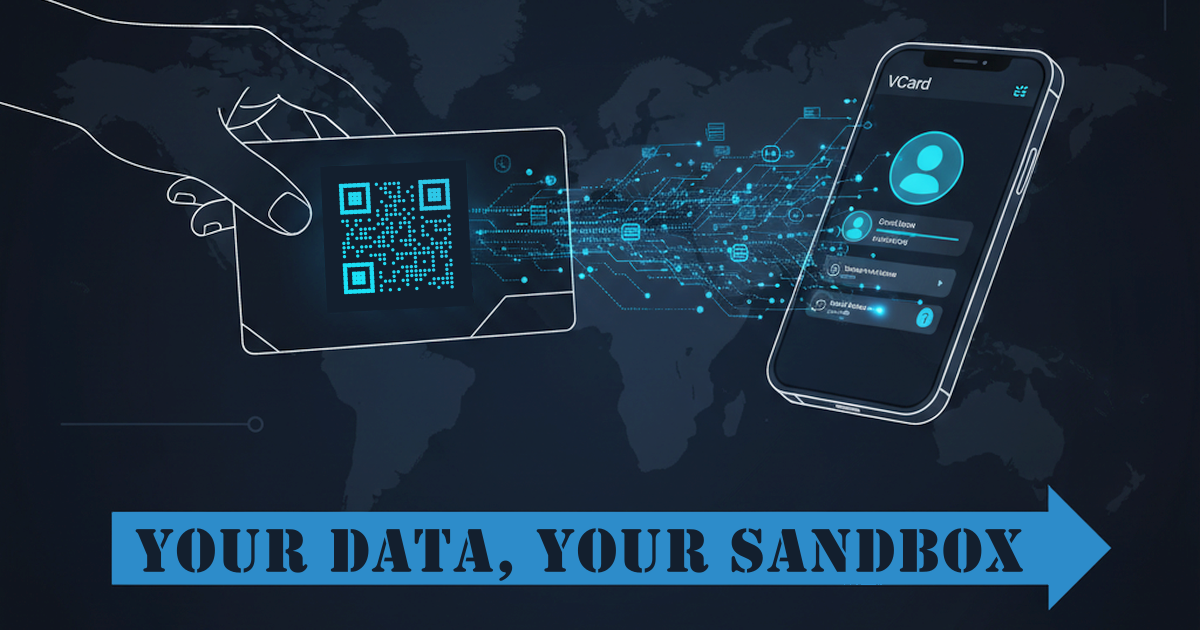
Why Privacy-First Matters for Local SEO & Trust?
Here's the uncomfortable truth that most "free" QR code providers don't want you to know: while you're handing over your professional information, someone else is harvesting data about everyone who scans your code. Your contacts' privacy becomes a commodity, and your reliance on third-party servers means your digital identity could vanish if a service shuts down or decides to charge you. (As we detailed in our report on "The Hidden Risk of Dynamic QR Codes").
At BeloMarketing.com, we believe this tradeoff is entirely unnecessary. We're committed to Phygital Sovereignty - merging physical presence with digital efficiency without the surveillance economy peering over your shoulder.
The Hidden Cost of "Free" Digital Business Cards
The proliferation of QR code generators has created a deceptive marketplace.
Companies offer slick interfaces and beautiful designs, but beneath the surface lies a troubling exchange: you get convenience and they get data. When someone scans a dynamic QR code created through these platforms, the scan request routes through the provider's servers first. This means they log every scan, building profiles of who interacts with your business card, when they do it and from where.
This surveillance model has three immediate consequences that should concern any privacy-conscious professional:
- You're placing your professional relationships in the hands of a third party who may change their terms, raise prices or shut down entirely tomorrow.
- The people you meet - your potential clients, collaborators, and connections - are being tracked without their explicit consent, potentially damaging the trust you're trying to build.
- Dynamic codes typically include expiration dates or require ongoing subscription payments, meaning you're never truly done managing your business card.
The solution isn't to reject digital business cards - it's to demand a better approach.
Enter the static vCard QR code, a technology that returns control to you while delivering everything dynamic codes promise and more.
Understanding the Static vCard QR Code Architecture
A vCard QR code represents a fundamentally different approach to digital contact sharing. While dynamic codes store only a URL that redirects to hosted information, a static vCard embeds your complete contact details directly into the QR pattern itself. The data lives within the pixels - every letter of your name, every digit of your phone number, every character of your email address encoded directly into the matrix.
This architectural distinction carries profound implications. When someone scans a static vCard QR code, their smartphone reads the embedded data directly and immediately triggers the native contact application. There's no intermediate server lookup, no redirect delay, no reliance on a third-party service remaining operational. The information exists in the printed code and nothing else is required to access it.
The most significant advantage of this approach is permanence. A properly generated static vCard QR code will work indefinitely. It cannot expire because there's no subscription to lapse. It cannot be revoked because there's no server permission to revoke. The code itself is the complete package, making it the only truly sovereign option for professionals who want their digital identity to outlast any particular platform or provider.
Why Privacy-By-Design Matters for Professional Trust
The connection between privacy practices and professional trust extends far beyond philosophical concerns. When you exchange contact information with someone, you're initiating a professional relationship built on respect. That relationship should not include invisible observers cataloging every interaction.
Privacy-first QR code generation addresses this directly through a technical approach called client-side processing. When you create a vCard QR code using this methodology, your contact information never leaves your browser. The encoding happens entirely on your device, which means no server anywhere has knowledge of your data except for you and the people you directly share it with. This elimination of data intermediaries represents a significant competitive advantage in an era of growing privacy awareness.
For local businesses specifically, privacy-conscious practices reinforce community trust. When a customer scans your storefront QR code, they know their interaction remains private. This respect for boundaries converts casual encounters into loyal relationships because customers recognize that you value them as people rather than data points to be exploited. The ripple effects show up in reviews, referrals, and long-term retention - metrics that matter far more than the metrics tracked by surveillance-based platforms.
Technical Implementation: Creating Your Permanent vCard
Creating a permanent vCard QR code requires understanding a few technical fundamentals that separate robust implementations from fragile ones. The vCard standard itself - known formally as VCF (Virtual Contact File) - defines how contact information gets formatted for electronic exchange. A properly formatted vCard begins with the version identifier (typically version 3.0 for maximum smartphone compatibility) and includes structured fields for your identifying information.
The essential fields you should include are your full name (FN), organization (ORG), title (TITLE), phone number (TEL), email address (EMAIL), website (URL), and physical address (ADR) if you operate from a fixed location. Avoid including excessive fields such as multiple phone numbers, social media handles, or extensive notes - each additional element increases the data density of your QR code, potentially making it harder to scan when printed at smaller sizes.
The generation process itself should occur entirely within your browser using JavaScript-based libraries that perform the encoding locally - like BeloMarketing QR Code Generator. This guarantees that your contact information never traverses the network during creation. The resulting QR code pattern represents your data encoded with error correction sufficient to remain scannable even with partial damage or wear. This resilience matters significantly for business cards and stickers that will be handled repeatedly over months or years of use.
Optimizing for Maximum Scannability Across Every Medium
A technically perfect vCard QR code fails if it can't be scanned reliably in real-world conditions. The relationship between data density and scannability is inverse: more information packed into smaller spaces creates patterns that challenge camera focus and processing algorithms. This reality demands thoughtful optimization strategies that balance comprehensiveness with practicality.
- The first optimization concerns physical sizing. While QR codes technically function at very small dimensions, reliable scanning requires adequate surface area. For business cards, we recommend maintaining a minimum print size of 1.5 centimeters square - larger if your design permits. This provides sufficient resolution for smartphone cameras to accurately decode the pattern without requiring perfect lighting or steadiness from the user.
- Color contrast represents perhaps the most critical scannability factor. The fundamental principle is dark patterns on light backgrounds for maximum reliability. Dark gray or black modules against white or cream backgrounds achieve the highest scan success rates because they provide the strongest contrast for image processing algorithms to distinguish modules from open spaces. While some generators offer colorful options, these introduce uncertainty that works against your networking goals. The professional approach maintains classic contrast for guaranteed functionality.
- File format selection during export significantly impacts long-term flexibility. Vector-based SVG (Scalable Vector Graphics) format should always be your choice because it ensures your QR code can be scaled to any size without pixelation or degradation. Whether you're printing standard business cards or enormous storefront signage, SVG preserves the precise geometric relationships that scanners require. Raster formats like PNG or JPEG introduce scaling artifacts that accumulate with each enlargement, eventually compromising scannability at larger sizes.
Securing Your Professional Identity for the Long Term
The decision to adopt a static vCard QR code represents more than a technical choice - it's a statement about how you value relationships and data sovereignty. In an era when digital platforms routinely demonstrate their unreliability through privacy breaches, terms of service changes and sudden service discontinuations, maintaining direct control over your professional contact information becomes a competitive differentiator.
Your business card serves as a physical touchpoint that extends your professional presence into the real world. By embedding your complete identity directly into that artifact, you eliminate every intermediary between you and your connection. No tracking scripts. No redirect analytics. No subscription reminders. Just your name, your contact information and an invitation to connect.
When you generate your vCard QR code using browser-based, privacy-first tools, you're not just creating a convenience - you're exercising sovereignty over your professional identity. That identity remains yours regardless of platform shifts, economic changes, or the strategic priorities of third-party services. It exists in your control, on your terms, for as long as you choose.
The future of professional networking is phygital - seamlessly bridging physical encounters with digital connection. But that future shouldn't come packaged with surveillance, dependency, or artificial expiration. We've built our generator to reflect what's possible when privacy and practicality align, and we invite you to experience the difference that genuine sovereignty makes in your professional interactions.
Now that you understand why static is the best standard, stop letting middlemen monetize your relationships.Generate your professional vCard QR code today with BeloMarketing.com 100% private, browser-based generator - no accounts, no tracking, no expiration, just pure sovereign technology that puts your professional identity firmly in your hands where it belongs.